
Decorum
Systems, rather than coercion, to allow children to meet expectations

This may come as a surprise to some readers, but I have relatively high expectations when it comes to my children’s behavior in settings that call for a certain decorum. Old-fashioned expectations, one might say. I take my young children to the library, the museum, classical concerts regularly. This is in part to give them access to culture, in part to let them know that they belong in such places, but also to work on what the social expectations are in each individual setting and how to meet them. We eat out regularly; culturally and personally, food is very important to me, and so are table manners.
What this looks like, in a non-coercive, non-punitive, relationship based parenting paradigm like the one I practice is that I take full responsibility for the outcome. I take responsibility before, during and after:
Before means that I set my children up for success. I make sure they are not dysregulated from lack of sleep, a cold, or excessive hunger. I make sure they have gotten ample vigorous play outdoors before. I make sure I have actually explained the expectations. And if I know from past hits-and-misses that their mix of temperament and stage of development simply means they aren’t going to meet expectations for that particular place now, I abstain.1
During means I am largely focused on them and on supporting them to behave appropriately. At different ages this may mean packing lots of entertainment — books, coloring, small toys, washi tape, fidgets, audio books and headphones; having a plan for going through the activity in a way that will be engaging to them (a favorite trick of mine when visiting arts museums is to start by the store and buy one postcard of their choice from the exhibition we are about to see. They can then walk through the museum looking for “their” piece of art. Once found, it’s often an interesting experience to contrast the reproduction with the original. And they like to look at the postcard afterwards to talk about that day.) Or simply remaining focused on them, attentive to their thoughts and their experience, in conversation throughout the event.
After means having an exit strategy if things take a turn for the worse2. Letting your dinner companions know that you may need to make a swift exit. Asking for the bill as soon as you order. And starting the outing in the right frame of mind, having already made peace with the fact that you may need to leave to hold the expectation.
Children do well if they can. Have you ever paused to consider how many demands are made of them, in a day out in the world? How many more points of friction they encounter than an adult?
Go ahead and do the exercise. Carry a notebook around and tally the things big and small you ask your child to do in a day. The things you ask them not to do, too.
Then tally as well the invisible demands made of them by an environment not planned with their needs in mind. The chairs they must climb on with upper body strength, and sit with their legs dangling, unsupported. The pretty outfits that they struggle to get out of, or must depend on an adult to remove. The walks or stroller rides with exhaust pipes at eye level. The stairs with a handrail simply set too high. The public transportation where they must stand with their nose at crotch or armpit level. The streets they must cross with zero visual information about oncoming traffic because they cannot see over the car parked on the corner. The very high pitch whine of electronics that their young ears haven’t yet gone deaf to. The automatic flushing system that does not detect their small bodies and gives them an unexpected, unpleasant splash. The sink that is out of reach. With so many indignities to suffer through daily, wouldn’t you, too, be likely to, as they say, crash out?
Maybe children failing to meet expectations of decorum in public aren’t going from 0 to 100 without warning. Often, I think, they go from 99 to 100, because they have already endured so much without a peep.
And a lot of that friction can be removed by planning the environment right.
This is to everyone’s benefits. A deliberately planned environment makes expectations more explicit, both for the children and for onlookers. This helps keep everyone on track. This removes some of the inherent frustration in mismatched expectations. And this disenchants children of the possible idea that behavioral expectations are something their parents made up and inflict on them just because. A well planned environment reinforces expectations and makes them make sense.
A lower demand environment preserves the small amount of self control of very young children (a precious commodity!), saving it for demands that cannot be mitigated.
And a prepared environment makes it easier for us to hold a firm boundary without relying exclusively on our own willpower (which also does not come in infinite supply).
Systems. Just like when it comes to building a life with the amount of screen time you feel is right, systems are what allow you to ensure your children are not in a position to fail to meet the behavioral expectations of a situation, without being exceedingly taxing to you, or to your relationship.
In the face of the evergreen complaint of children in transportation, here is one example of a deliberately prepared environment. In German long distance trains, two types of family seats are available. The first is a toddler area:
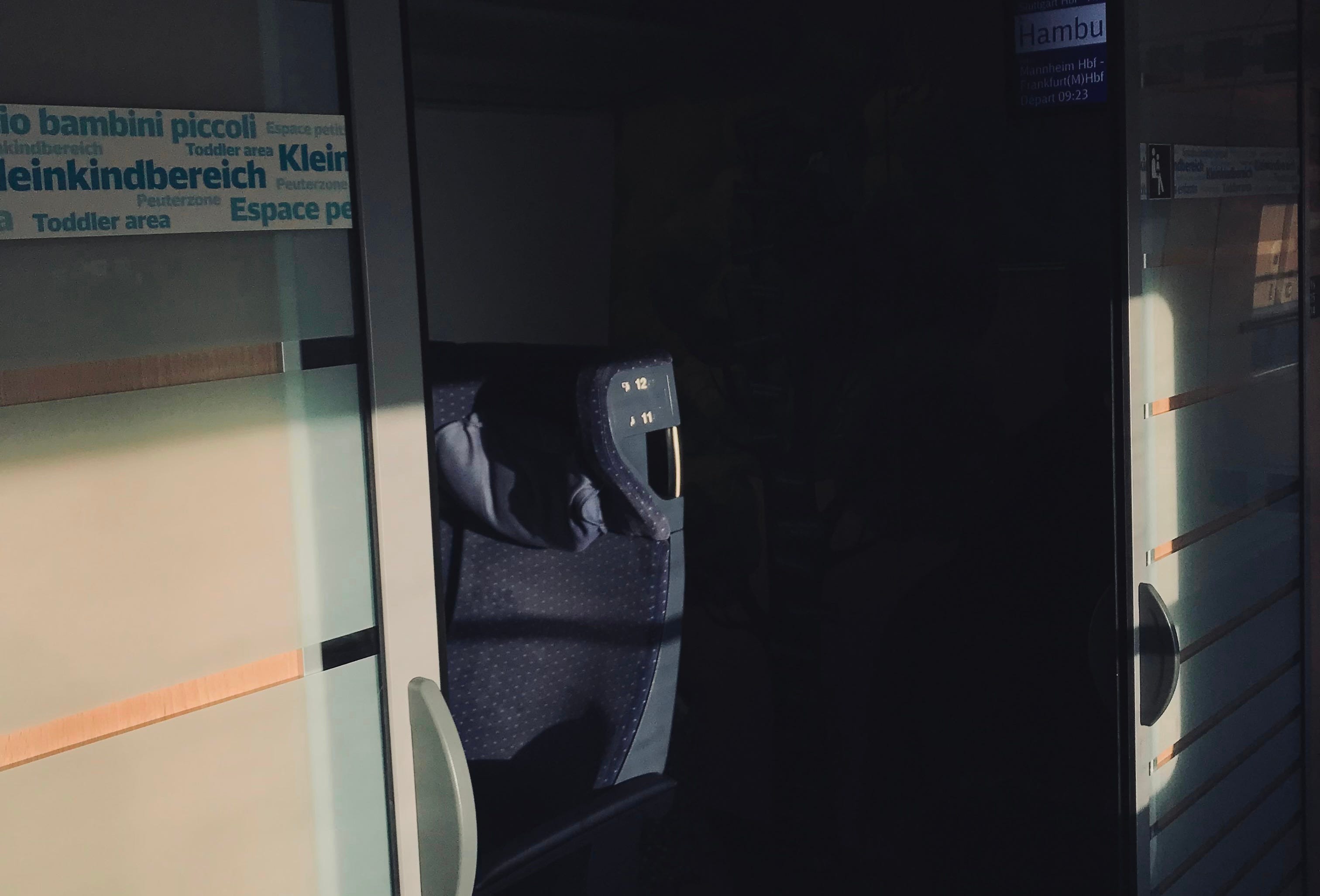
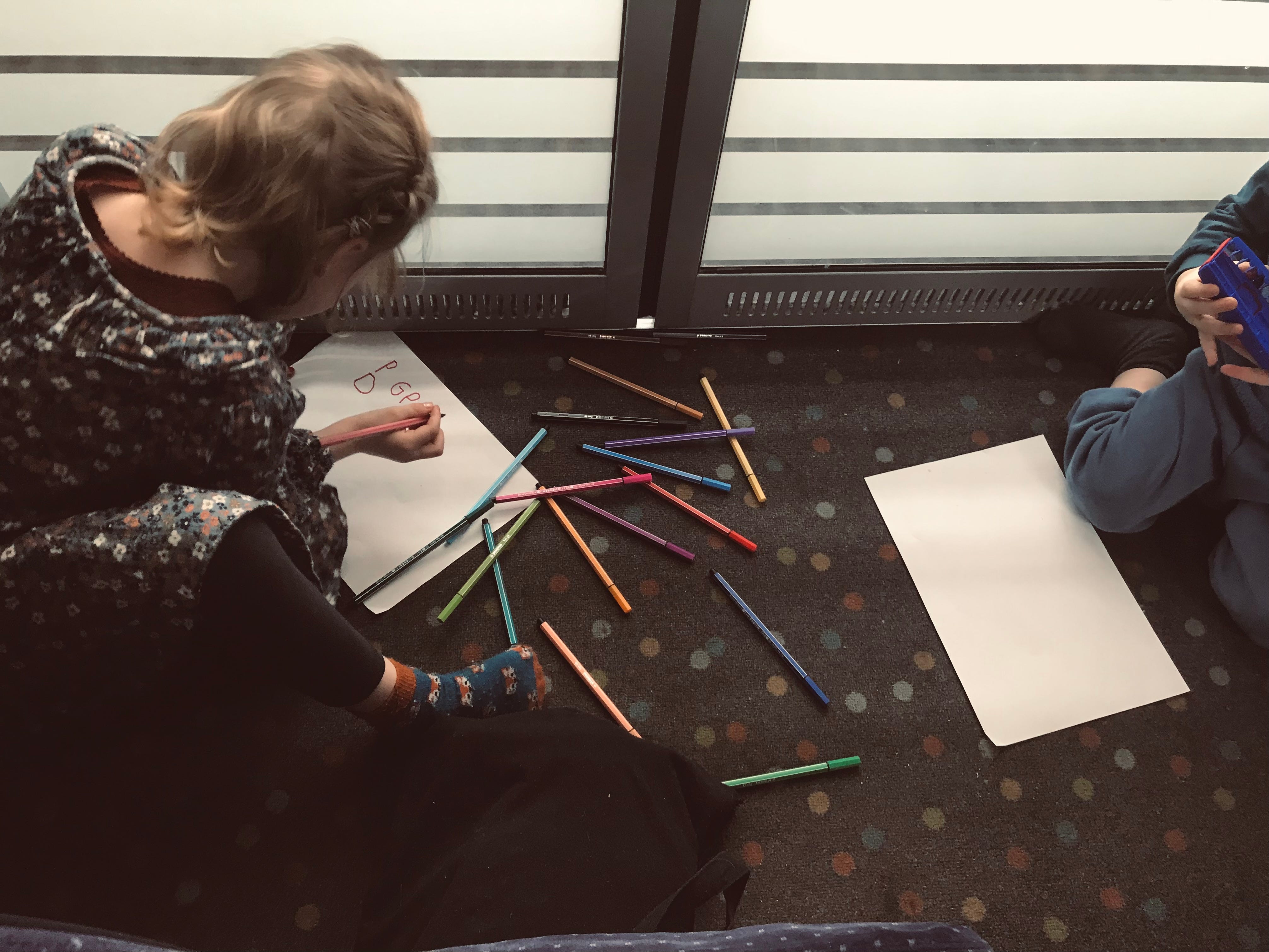
This five-seat cabin can be closed. This means small children can get out of their seat and play, get some toys out, roll around on the floor… do what it takes to get through 6 or 8 hours of travel in a small space, and not find themselves in the way of other passengers.
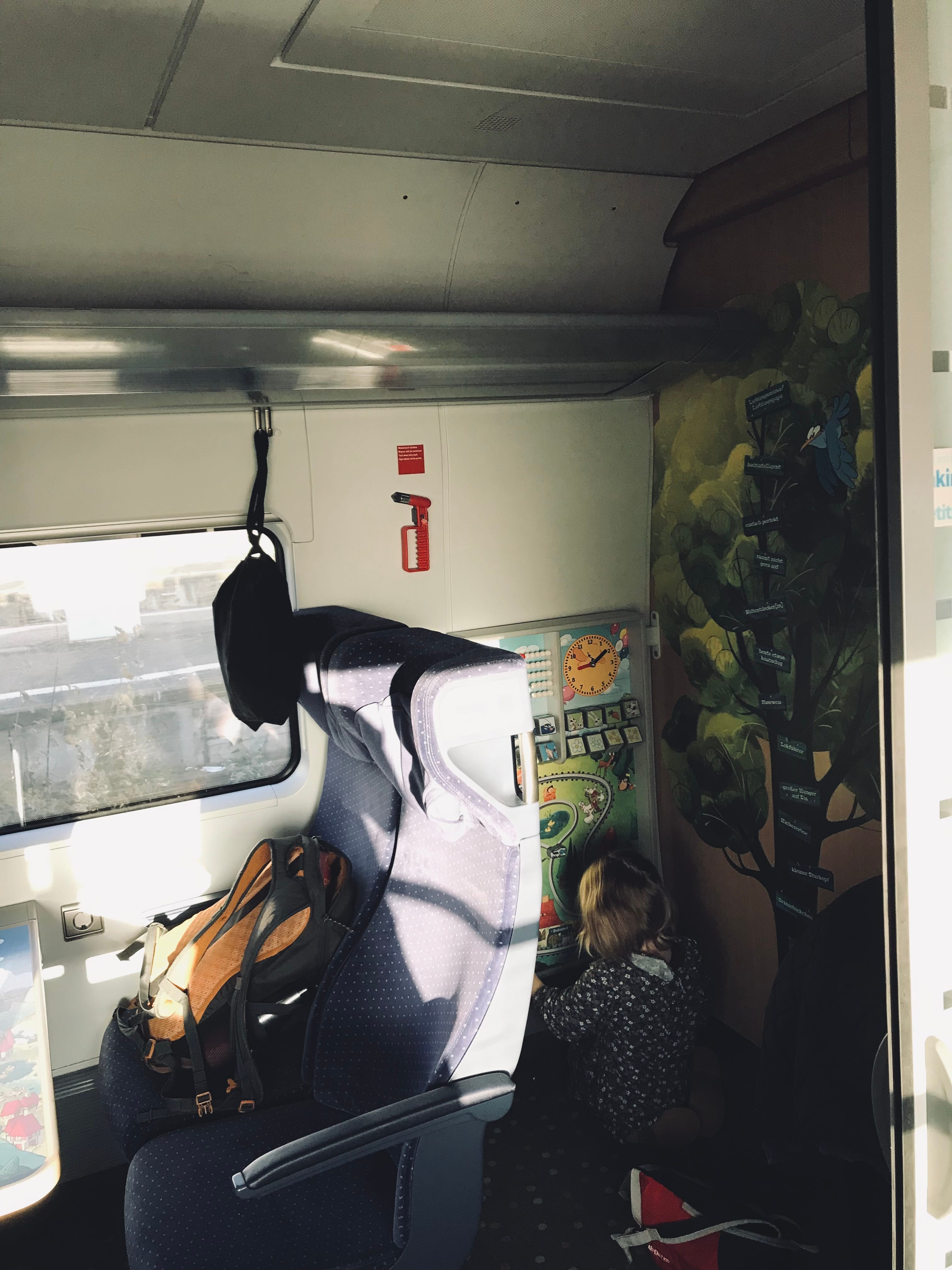
Behind the seats is enough dead space to park a stroller and store your luggage — or, again, move. The walls are covered in small manipulable games, as is the central table.
Other minor adaptations can be found: in this cabin, electric plugs are childproofed, for example.
The second type of family seating is the family area. This is in fact a standard seating in a standard car. The only specificity is that it is close to the on-board bar and to the restroom with a changing table, and, critically, that the family-friendliness of this area is on display.
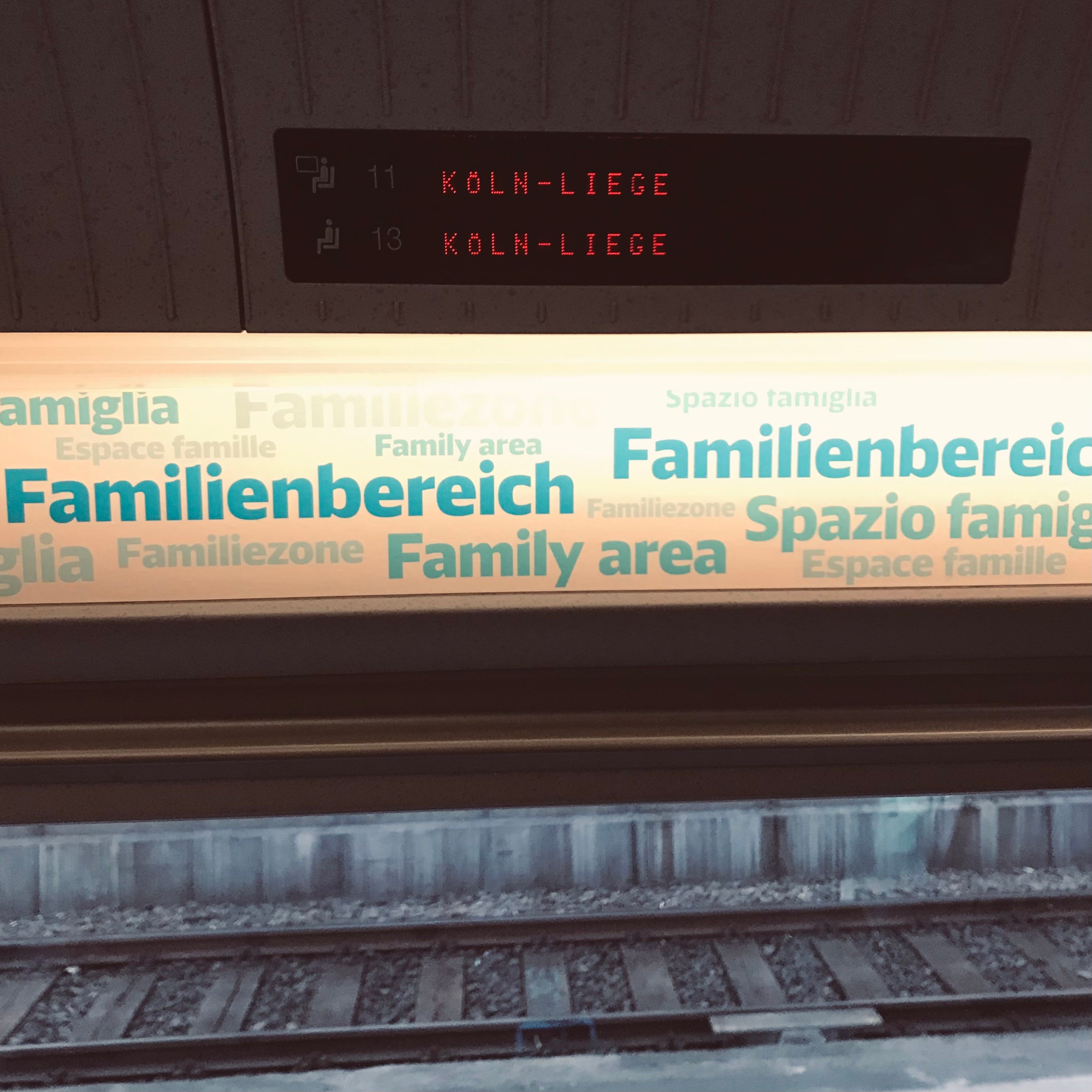
This is an institutional reminder that children belong here, to any childless traveler who might sit nearby. Sometimes all the seats in the quiet car were booked and that’s where you unexpectedly have to sit! But that’s the expectation here.
Both areas bring the wonderful benefit of, obviously, attracting families. I have talked at length before about how much play is facilitated by peers. Here, peers come built in. I have done a lot of solo travel by train with one and later two children. In these areas, they always make a friend for the ride, and with only minimal amounts of support, can entertain themselves appropriately for the duration.
I hope this can inform your perspective. If you find yourself moving through spaces that are deeply hostile to children, if only in their indifference, let that prevent you feeling frustrated at children. They are only doing their best in trying circumstances. If you are in a position to improve a space, do so, and spread the word!
But what about when you don’t have a choice? My husband and I tag team events and outings a lot. If we don’t think a party will work for one of the kids, only one of us goes and the other stays with that child at home. And I have put in a lot of effort to build community that trades watching children so that I am less often in that bind. But yeah, sometimes abstaining is not really possible. I still try and pull all my tricks — I take books and board games for the doctor’s waiting room or in our hospital bag, I keep a little pouch of junk in my purse with high value items like a bubble wand, the best stickers and glitter glue. I know where the secret outdoor playground is at the airport. But sometimes, everything still goes wrong and you cannot abstain or leave. In these cases, it’s a matter of lens. Keeping in mind that I asked my child for a favor in asking for a particular outcome that I had no means of enforcing, and they aren’t in a position to do me that favor. Keeping in mind that this was an expected outcome. Keeping in mind that I am the one responsible for these outcomes, this was on me, and there’s no reason to get annoyed or mad or overly demanding at a melting down child in what is definitely not a teaching moment. Sometimes things just are a mess, you know?
It’s not a “if you can’t stop touching the art, we’re leaving” type of situation. A similar looking action, perhaps, but as part of the aggregate of a million actions a totally different color. For one thing, I don’t really issue this type of challenge. Challenging the child to change their behavior means letting them continue. I don’t mean “let” as in approve of; I mean literally letting it happen, leaving them in conditions in which the behavior can occur. And is likely to occur, since nothing really changed since a moment ago when they just did. This is the worst kind of reinforcement, signaling that when you said “don’t touch the art”, you really meant “except for all the chances Im going to give you at touching the art even though I don’t like it!” It may look and sound strict, but it really establishes every boundary as a little porous and a little stretchable. For another thing, it’s entirely too many words for a child in the process of losing all self control. I say little, or maybe nothing at all as we leave. And lastly, this kind of behaviorist framing (the child is misbehaving because they don’t want to stop touching the art; a threat of punishment will incentivize them) rests on the expectation that this is a teaching moment. That’s what behaviorism does, it aims to teach behavior. But the aim of a boundary is tautological. If I hold a boundary of not letting my kids touch the art, it is so that the art does not get touched. It’s all that matters. Learning happens incidentally— learning how to act in a museum, learning that when I say something I am for real (one of the most important things you can be to your kids, in my opinion). But by thinking about boundaries as simply being for what they say they are, I protect my lens, my long term trust, relationship centered lens.
I love this! In addition to it being important to use the save limited self-control for situations where the need for it cannot be mitigated, I've always noticed that kids, even young kids, are very good at telling the difference between the situations where it can and cannot be mitigated and often handle the situations in which we are doing all we can for them and facing something hard together so much better than they would handle being made to face something hard for no reason other than to practice doing hard things.
Love this perspective so much. I find this communicative framework not only more respectful but also **more realistic** in daily life than "because I said so"/punitive approaches! At least for my family's particular personality+skills mix. We've been practicing our "museum manners" and "restaurant manners" some lately, and it is messy but imo worth it.